



Why Do Architects and Designers Call the Ceiling The “Fifth Wall”?
Look up in almost any well-designed space and you’ll understand why architects refer to the ceiling as the fifth wall. In a single surface, the ceiling establishes proportion, controls light, reinforces brand identity, and plays a major role in acoustic comfort. Unlike vertical walls, it spans uninterrupted across rooms, guiding how spaces connect and how people experience them.
So what is the fifth wall really? It’s the idea that ceilings are not just a place to hide mechanical systems, but a high-impact design and performance layer. When used intentionally a fifth wall ceiling does far more than cover MEP (Mechanical, Electrical, and Plumbing) – it actively shapes how a space looks, feels, and sounds. The sections below explore how architects and designers can leverage ceilings as visual, acoustic, and technical assets.
Visual Power: How the Fifth Wall Shapes Space
The ceiling is often the largest continuous surface in a room, which gives it outsized influence over perception. Before materials, furniture, or signage register, the ceiling sets the spatial tone. Through form, pattern, and light, the fifth wall can make a space feel calm or energetic, intimate or expansive.
Proportion & Scale
Ceiling geometry has a direct impact on perceived scale. Lowered planes can bring comfort to large volumes, while raised or sloped ceilings emphasize openness and hierarchy. Covers, steps, and subtle elevation changes allow designers to tune how different zones are read without adding physical barriers.
These moves are especially effective in mixed-use interiors – lobbies that transition to corridors, or open offices that flow into collaboration areas – where the ceiling quietly signals shifts in use.
Rhythm, Wayfinding & Brand
Repetition is a powerful spatial cue, and ceilings are ideal for establishing it. Linear elements, reveals, and modular spacing naturally guide movement through a space. In branded environments, ceiling patterns can echo visual identity through plank spacing, perforation layouts, or controlled color fields.
Because the ceiling connects multiple rooms visually, it often becomes the unifying element that ties a project together, even when wall finishes change.
Light as a Material
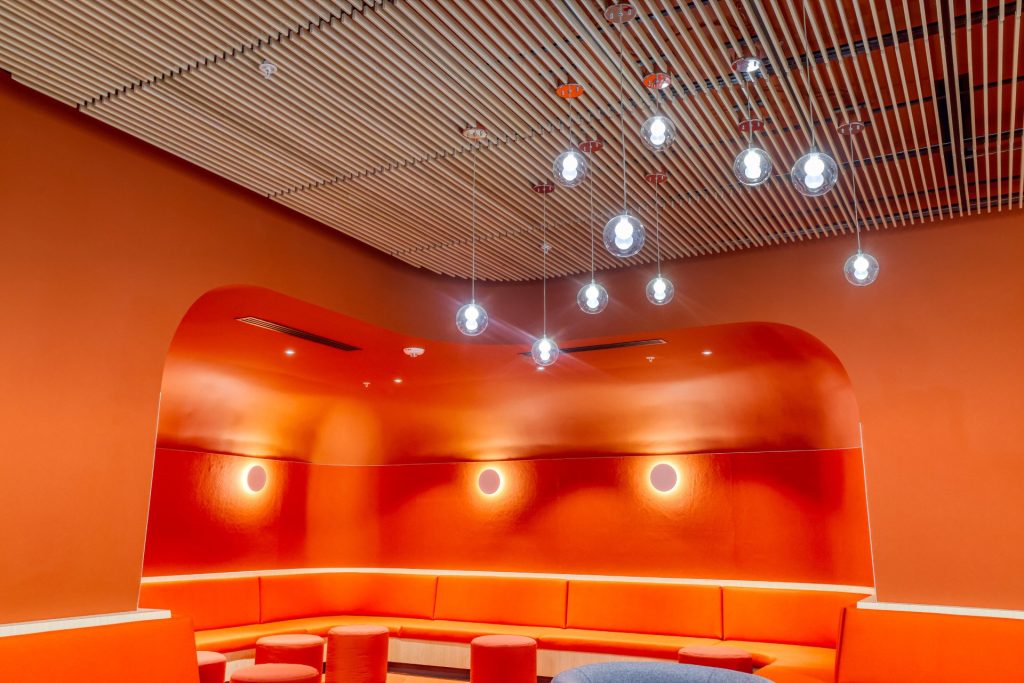
Lighting should be conceived as part of the ceiling, not simply attached to it. Aligning linear fixtures with ceiling modules reinforces visual order and reduces clutter. In some applications, the ceiling itself becomes luminous – using translucent panels or a back-lit perforated ceiling to deliver soft, even illumination.
Behind the scenes, acoustic backers and liners help support plenum light diffusion, preventing harsh contrast and maintaining a clean visual field.
Acoustic Power: Turning Ceilings into Quiet Machines
While the visual role of the ceiling is easy to see, its acoustic role is often just as important. In many interiors, the ceiling provides the largest opportunity for meaningful sound control, especially in open or high-occupancy spaces.
Absorption (Panels, Clouds, Baffles)
Speech clarity depends on managing reflected sound. Acoustic ceiling design focuses on absorption to reduce echo and improve intelligibility. Because ceilings offer broad surface area, even partial coverage can result in measurable NRC (Noise Reduction Coefficient) improvements, particularly in open offices, classrooms, and collaborative spaces.
When full-field ceilings aren’t feasible, targeted elements like fabric ceiling clouds or acoustic baffles allow designers to add absorption while maintaining visual openness.
Diffusion & Shaping
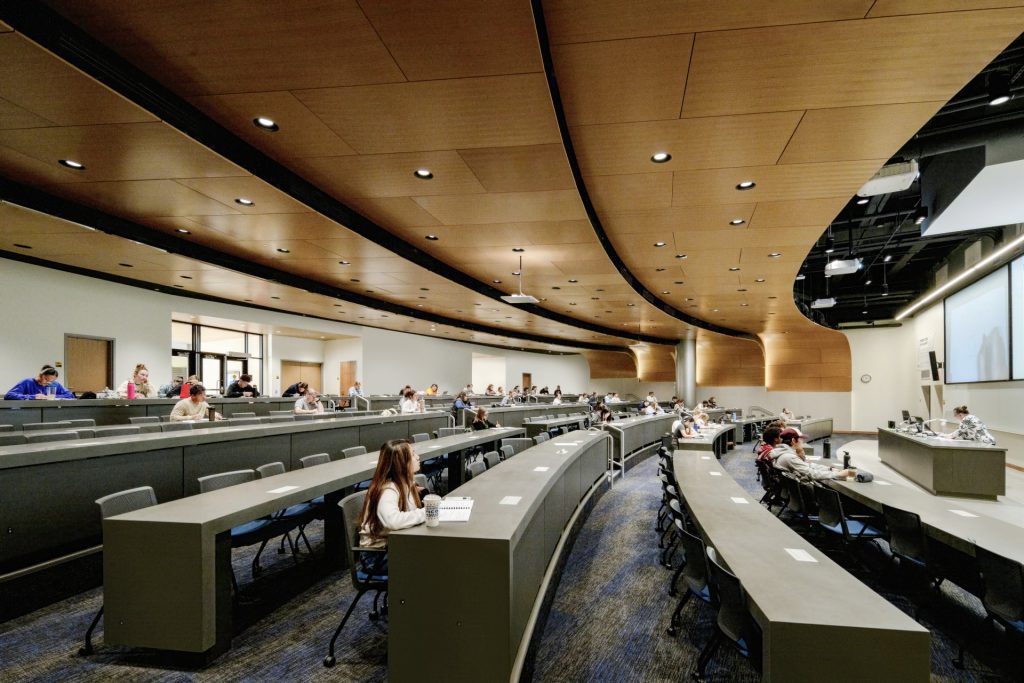
In larger rooms, absorption alone isn’t enough. Articulated ceiling forms – angled planes, coffers, or sculpted surfaces – help scatter sound energy, reducing slap echo and uneven distribution. This type of shaping supports balanced reverberation control while preserving the liveliness required in lecture halls, worship spaces, and performance venues.
Don’t Confuse Treatment with Soundproofing
It’s important to clarify acoustic treatment vs soundproofing. Ceilings primarily improve sound within a room by absorbing and diffusing reflections. Preventing sound from traveling between rooms still relies on walls, doors, and coordinated plenum design. A high-performing ceiling enhances ceiling acoustics, but it works best as part of a holistic strategy.
Material Palettes for the Fifth Wall (Pick the Look, Tune the Sound)
Material choice defines both the character and the performance of the fifth wall. The visible surface establishes aesthetic intent, while perforations, geometry, and backing determine acoustic behavior.
Wood: Warmth & Directionality
Wood ceilings introduce warmth and a sense of direction. Linear wood planks and wood grille ceiling systems are commonly used to guide movement along corridors or frame gathering areas. On their own, wood surfaces are reflective, but adding kerfs or perforations with acoustic backers transforms them into absorptive systems.
Options like micro-perforated wood allow designers to maintain a clean, refined look while achieving targeted NRC values.
Metal: Precision & Cleanability
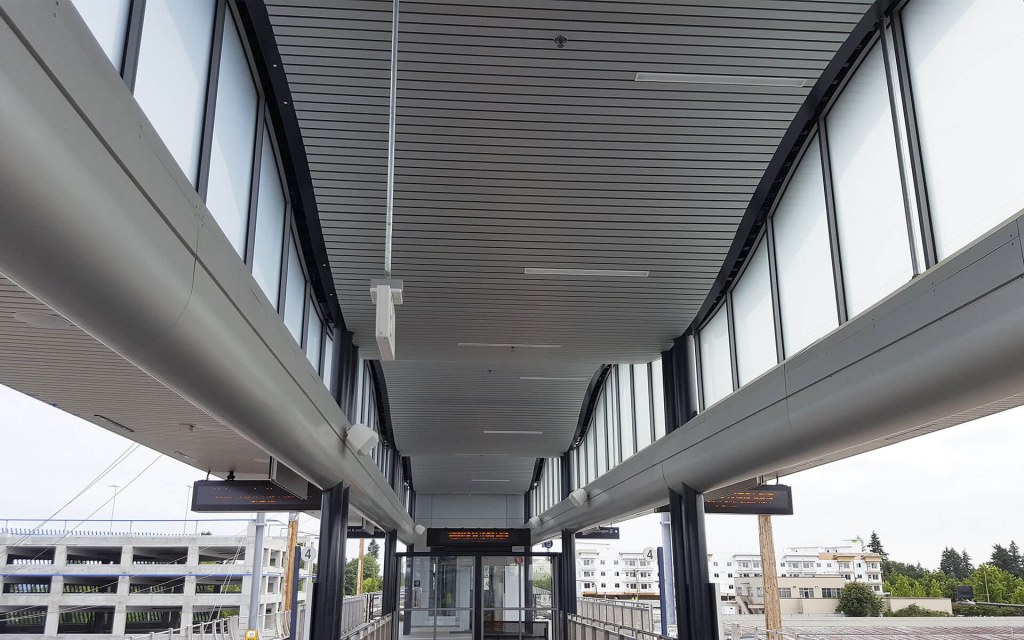
Metal ceilings deliver crisp geometry and durability. A perforated metal ceiling paired with an acoustic backer provides absorption while meeting cleanability and maintenance requirements – making it well suited for healthcare, transportation, and other high-use environments.
Metal systems also perform well where humidity, sanitation, or long-term durability are priorities.
The Hidden Layer: Backers Make Ceilings Work
What sits above the visible ceiling often determines whether or not it succeeds long-term. Acoustic backers and liners are the unseen components that transform decorative surfaces into functional systems.
Acoustic Lift (NRC & Bandwidth)
Backers extend absorption across a wider frequency range and significantly increase NRC. Materials such as bonded acoustical cotton provide predictable performance without loose fibers, helping ceilings address both speech frequencies and background noise.
Flatness & Anti-Sag
Backers also support panel stability. They contribute to flatness, resist deflection, and provide ceiling anti-sag performance – especially important for large-format panels. In challenging environments, pairing the right backer with a humidity-resistant ceiling assembly protects alignment and finish over time.
Visual Hygiene & Light Control
From the occupied space, the best backer is invisible. It hides plenum conditions, prevents fiber show-through at perforations, and supports even illumination. Where codes require it, a Class A fire-rated backer delivers compliance without compromising appearance.
Coordination & Spec Notes
Even the best ceiling system can underperform without proper coordination. Clear documentation and early collaboration help ensure the fifth wall performs as intended.
Call Out the Backer
Backers should be explicitly specified – not assumed. Include material type, thickness, fire rating, mounting method, and any intentional air gap on reflected ceiling plans and details.
Penetrations & Continuity
Lighting, sprinklers, and diffusers interrupt acoustic layers if not detailed carefully. Maintain continuity with rings or pans and align penetrations with ceiling modules to protect both aesthetics and performance.
Plenum Strategy & MEP
Successful ceilings balance acoustics with airflow, lighting, and access. Coordinating MEP early prevents late-stage compromises and preserves the integrity of the acoustic layer.
Mockups & Commissioning
A ceiling mockup and commissioning process allows teams to verify flatness, seams, reflected glare, and perceived sound quality before full installation – reducing risk and ensuring outcomes match intent.
ASI Architectural Systems for the Fifth Wall
ASI Architectural ceiling systems are designed to help architects and designers fully leverage the fifth wall – balancing visual intent, acoustic performance, and long-term durability. Each system can be paired with engineered acoustic backers to tune sound absorption, control reverberation, and support clean detailing across a range of applications.
Grille Ceilings
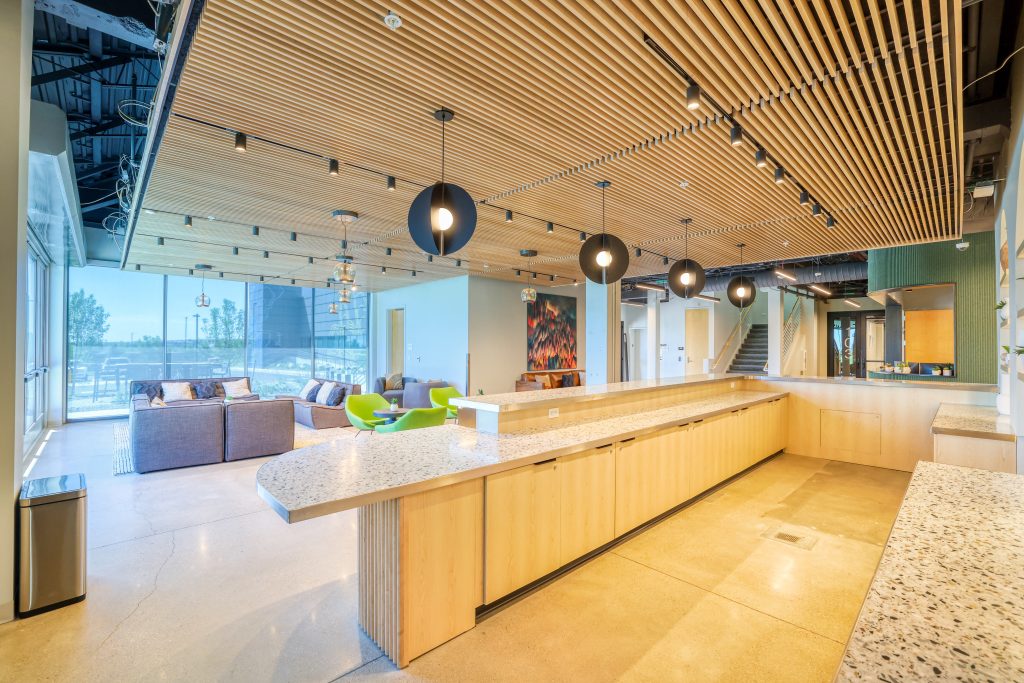
Grille ceilings use directional wood slats to create rhythm, warmth, and a strong sense of movement. They are frequently specified in corridors, lobbies, and large open spaces where wayfinding and visual continuity matter. While visually open, grille systems can be acoustically effective when paired with hidden acoustic liners or backers above the slats. This combination allows designers to maintain transparency to the plenum while still achieving meaningful absorption and reverberation control.
Linear Wood
Linear wood ceilings provide a refined, contemporary expression through reveal-based or tongue-and-groove plank layouts. These systems are often used to define circulation paths or highlight key architectural zones. Because solid wood surfaces are naturally reflective, adding an acoustic backer above the reveal-spaced planks is essential for improving ceiling acoustics in corridors, offices, and public interiors. The result is a clean, continuous fifth wall ceiling with balanced sound performance.
Fusion (Perforated Wood)
Fusion perforated wood systems combine the warmth of wood with integrated acoustic functionality. Kerfs or perforations in the face material are paired with an acoustic fleece and optional 1-2” backers to deliver tuned NRC improvements. Fusion is well suited for spaces where designers want the ceiling to read as a refined wood surface while quietly handling absorption behind the scenes.
Audition (Kerf / Linear Panels)
Audition kerf panels emphasize precise line work and controlled repetition, making them ideal for spaces that demand visual order and acoustic clarity. Integrated Soundtex and/or bonded acoustical cotton are optional backers that allow these systems to manage reverberation effectively without adding visual bulk. Audition ceilings are commonly used in conference areas, classrooms, and performance-oriented environments.
Microperf (Wood or Metal)
Microperforated wood systems offer a sleek, monolithic appearance with evenly distributed micro-perforations. Available in wood or perforated metal panels, they pair seamlessly and can be used with or without acoustical backers to deliver consistent absorption across the ceiling plane. These systems are ideal where minimalism, subtlety, cleanability, and performance must coexist.
Clouds & Canopies
Ceiling clouds and canopies provide targeted acoustic control without full ceiling coverage. Suspended below the structure, they are effective in retrofits or spaces with exposed MEP where absorption is still required. When paired with absorptive backers, clouds offer flexible reverberation control while preserving architectural openness.
Acoustical Backers
Acoustical backers are the hidden performance layer behind many ASI ceiling systems. Soundtex fabric or bonded acoustical cotton panel-type backers deliver predictable absorption, aid light diffusion, and are available with Class A fire-rated backer documentation. By selecting the appropriate thickness and mounting strategy, designers can fine-tune NRC, protect long-term flatness, and ensure the fifth wall performs as intended.
Beyond the Surface: Engineering the Sound
The finish defines the look and the absorptive backer defines the performance. When ceilings are treated as engineered systems rather than decorative afterthoughts, they deliver lasting comfort and clarity.
If you’re designing with the fifth wall in mind, ASI Architectural can help translate intent into performance. Share your ceiling type, target NRC, module sizes, and plenum depth, and our team will recommend backer options, mounting details, and spec language – so the fifth wall performs exactly as drawn.